The boy and his parents
The Painted BirdThe boy and his parents are separated by a decision made to preserve his life, then kept apart by the dislocations of war. The relationship is shaped by an unresolved interval: his parents hope for reunion, while the child continues to imagine their return without knowing where they are or whether they can find him. When they appear again, recognition is immediate but confirmation remains suspended at the moment he begins to expose a distinguishing birthmark.
A separation meant to protect
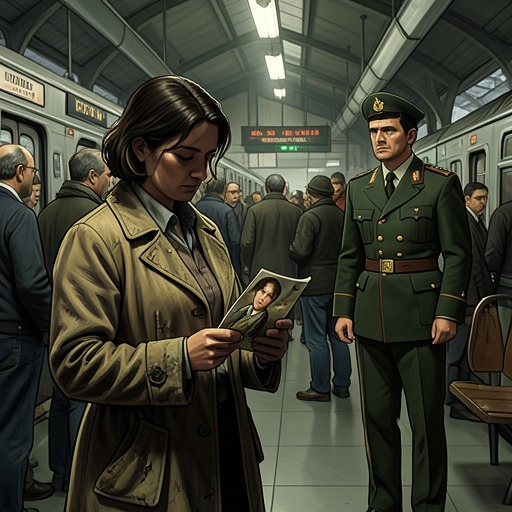
In the fall of 1939, during the first weeks of the Second World War, the boy is six years old. His parents send him from a large city in Eastern Europe toward a distant village, part of a wider movement of children away from danger. They entrust him to a man traveling eastward, who accepts substantial payment to find temporary foster parents. Their decision is not an abandonment in intention: because the father’s prewar anti-Nazi activities put the parents at risk of forced labor in Germany or imprisonment in a concentration camp, they believe sending the child away offers his best chance of surviving the war. They expect that they may eventually be reunited.
That plan depends on a chain of people and circumstances the parents cannot control. War and occupation bring repeated population transfers, and the parents lose contact with the intermediary who placed their son. They must contemplate that they may never find him again. The boy, meanwhile, has no comparable knowledge of what has happened. His foster mother dies within two months of his arrival, leaving him to move from village to village, alternately sheltered and driven away. The protection his parents arranged is therefore temporary twice over: first by design, then through the collapse of the arrangement itself.
The danger around the separation is not abstract. The boy’s olive skin, dark hair, black eyes, and speech mark him as unlike the fair-haired, light-eyed peasants among whom he lives. He is regarded as a Jewish or Gypsy stray, and the occupation makes sheltering people identified in those categories a perilous act for individuals and communities. German occupation forces also require the villages to surrender much of their limited produce, while refusal can bring punitive raids. The forces that separate the family thus include both the parents’ urgent fear for their child and the wider violence that makes ordinary protection precarious.
Waiting without news
At Marta’s hut, the boy expects his parents to come for him at any day or hour. The expectation gives his separation a daily shape: he is physically housed by another adult, but his attention remains fixed on the family from whom he has been sent away. Marta does not respond to his crying, and the relationship he longs for is not replaced by a dependable new bond.
When Marta’s hut is destroyed, the boy escapes and wakes at dawn to find only scorched wood and ashes where it stood. In the silence, he still believes his parents might know what has happened to him, even from far away. He calls out in case they are near; no one answers. Cold, hungry, and unsure where to go, he confronts the difference between imagining parental protection and receiving it. The scene does not establish that his parents have died. It shows instead that he cannot reach them and has no way to know when, or whether, they will reach him.
Survival and the absent family
As the years apart continue, survival increasingly depends on knowledge and work rather than family care. The boy remembers practical advice about plants, animals, and fire, and the equipment needed to make a small portable stove becomes an important means of keeping warm and preparing food. This practical independence does not resolve the separation; it marks how much he must manage without his parents. Later, Lekh takes him on because his small, light body allows him to set bird snares in places Lekh cannot reach, including slender branches and waterlogged ground. The boy’s labor earns him a place in another household, but the arrangement is organized around usefulness, not a restoration of the family bond.
In the orphanage, the separation is shared by many children but remains intensely personal. There are five hundred children, including children with serious disabilities and losses, and one boy in the narrator’s classroom repeatedly asks for his father. The scene places the boy among others who also lack a parent’s presence, while showing how little such shared loss can repair. Older children mistake his inability to speak for intellectual disability and sometimes beat him; he feels trapped and fears that injuring someone in self-defense could end his hope of returning to Gavrila. His parents remain the family he has lost, even as his immediate hopes and anxieties become entangled with the people and rules of the orphanage.
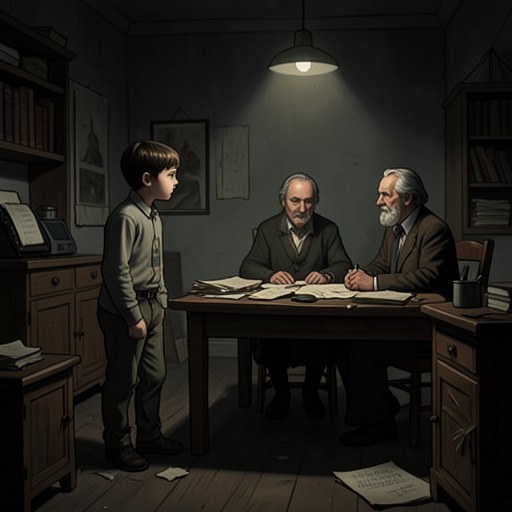
A commission’s questions expose how guarded that hope has become. When an older member asks what the boy knows about where his parents planned to go, the boy pretends not to understand and writes that they are dead, killed by a bomb. The claim is a concealment, not evidence of their fate. It allows him to shut down questioning at that moment, but it also shows that the possibility of reunion is something he protects rather than openly entrusts to officials.
Recognition, testing, and the unfinished reunion
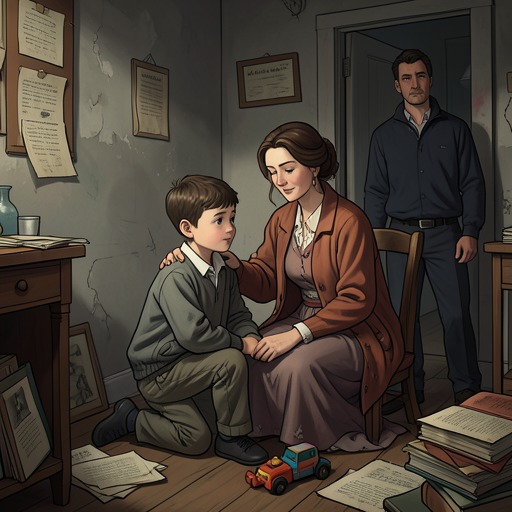
The relationship returns to the foreground when the orphanage principal and the commission member who had questioned him summon the boy. The man brings a woman and a man from an adjoining room. Their faces seem familiar to the boy, and the resemblance is strong enough that he wonders whether they could be his parents. He grips his chair and tries to keep an indifferent expression, caught between acknowledging recognition and pretending not to recognize them.
The woman bends toward him in tears. The man, shaking before he regains composure, speaks to him in Russian and asks him to unbutton his uniform: he says there should be a birthmark on the left side of the boy’s chest. The boy knows it is there and hesitates, aware that revealing it would remove doubt that he is their son. He finally begins to unbutton the uniform because he feels sorry for the crying woman. The scene makes bodily recognition a test of identity, but the available account stops at the beginning of that disclosure; it does not describe what follows.
The relationship’s significance
The boy and his parents are defined by opposing experiences of the same separation. The parents act out of a protective calculation and lose contact through wartime upheaval; the child experiences the absence directly, first as an expectation that they will come, then as a condition he must survive. His false report that they are dead and his hesitation before the birthmark test do not erase the bond. They show the distance that has grown between the parents’ intention to save him and the boy’s uncertain, guarded experience of being lost to them.
The reunion scene gathers the relationship’s central tension into a small sequence: familiar faces, uncertainty, tears, a spoken request, and the child’s pause before proof. The parents’ return is presented not as a simple restoration but as a moment that must pass through recognition after years in which neither side could rely on contact. By ending at the threshold of confirmation, the account preserves both the strength of the family connection and the vulnerability created by their long separation.